Turns a clinician’s typed or spoken post-session recap into editable SOAP, DAP, BIRP, GIRP, or PIE therapy-note drafts.
Abridge
NewEnterprise clinical documentation with encounter-grounded drafts, linked evidence, chart workflows, nursing, and clinical assistance.
AI Document Processing ToolsSee website
abridge.com
On this page
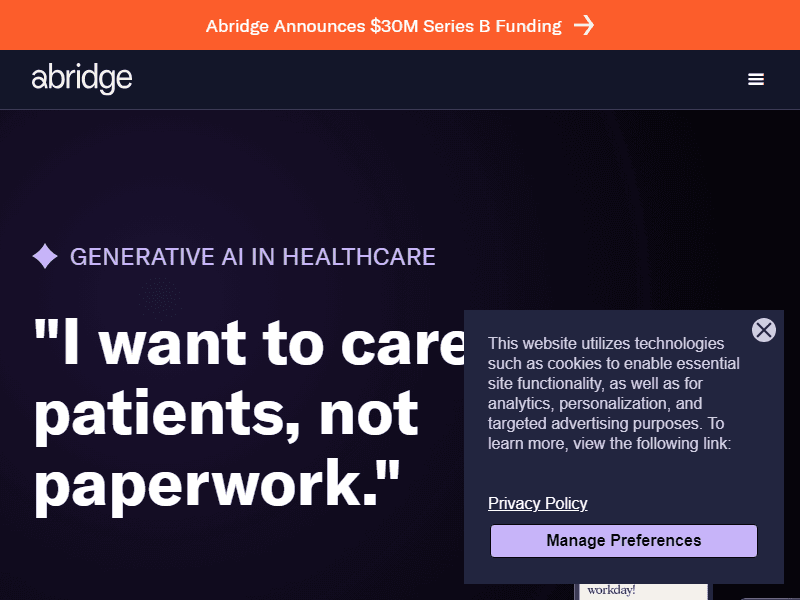
Abridge is an enterprise clinical AI platform that turns patient-clinician conversations into structured documentation and connects that work with a health system's electronic health record. Its current platform includes experiences for clinicians, nursing, and revenue cycle teams, alongside a clinical assistant. The central workflow is a draft grounded in the encounter, followed by professional review and completion inside the organization's established process.
That makes Abridge a different purchase from a general meeting recorder. A health system evaluating it needs to consider the encounter, chart context, destination fields, review responsibilities, and organizational access together. The official platform overview presents the product across preparation, the visit, and work after the visit. Which parts are enabled depends on the organization's deployment and agreement.
Ambient documentation for clinicians
Abridge's clinician experience uses the encounter conversation to prepare a specialty-oriented note for review. The platform also presents relevant history and clinical context before a visit and supports editing after it. The practical attraction is a connected documentation flow: the conversation, generated draft, and chart destination belong to the same encounter rather than being managed as unrelated files.
The product documentation overview describes an Epic-connected workflow, including mobile capture and desktop review. It also describes contextual information such as prior encounters and clinician preferences. An organization should confirm the exact EHR connection it is buying, the chart information available to the product, and where each output appears. Support for an EHR family does not answer every question about a particular instance and configuration.
When reviewing a note, separate three questions: did the system capture the relevant discussion, did it represent that discussion correctly, and does the final document fit the chart's purpose? A clear paragraph can still contain an incorrect speaker attribution or an unsupported detail. The clinician's review should examine the content, not simply whether the wording looks polished or the sections resemble a familiar template.
Linked evidence makes a draft easier to inspect
Abridge supplies a review mechanism called Linked Evidence. Its support guide describes selecting note text to inspect the associated transcript and listen to relevant audio. This is useful when a reviewer wants to check a statement without searching through an entire encounter recording. It gives the reviewer a route back to the underlying conversation.
Consider a draft that describes when a symptom began. A reviewer can inspect the supporting segment to see whether the timing came from the patient, another participant, or a question posed by the clinician. This distinction matters because a question is not itself evidence that the patient reported the condition. The final wording should preserve the encounter's meaning rather than merely reproduce a plausible clinical sentence.
Evidence links support review; they do not replace it. A transcript can be incomplete, a passage can be ambiguous, and a generated summary can overstate what the linked segment establishes. If the source does not support the draft, the useful response is to correct or remove the statement and complete the document through the normal clinical process. Keep responsibility for the final note explicit when defining the rollout.
Capture, editing, and the chart destination
The recording basics guide describes starting, pausing, resuming, and completing an encounter recording, with consent handled according to the organization's requirements. It also describes identifying the patient and generating a note from the encounter. These controls matter in practice: a pause, interruption, or switch between encounters can affect which information belongs in a draft.
Set up a review exercise around an interrupted conversation rather than only a continuous demonstration. Check that the right patient and encounter remain associated with the resulting note and that material outside the intended capture is not assumed to exist. The support instructions describe one documented workflow; clinicians should follow the controls and consent procedure supplied for their organization's current application and EHR integration.
The web editor guide describes desktop note editing and a route to Epic. A useful deployment review follows the output all the way to its destination. Confirm what is transferred, what remains editable, and who completes the final chart action. A successful draft in a separate window is only an intermediate result if the clinician still has unresolved work in the record.
Abridge Assistant and chart context
Abridge Assistant supports questions that use patient chart context and cited medical sources. Its documented tasks include summarizing chart information, drafting documents such as referral or handoff material, and assisting with supported medical calculations. The assistant is presented as an organization-enabled capability, including access for clinicians who may not use ambient documentation themselves.
For a chart summary, the useful review begins with the question's scope. Ask for the relevant encounter history rather than an unrestricted summary when the task concerns a specific visit. Inspect whether the answer relies on the intended chart information and open the cited sources for statements that require support. The presence of a citation makes the source inspectable; it does not establish that the source resolves the particular patient's situation.
Abridge's enterprise readiness discussion describes evaluation of clinical support and distinguishes assistant output from text automatically inserted into the note. That separation is useful for governance. A clinician can consider an answer, inspect its basis, and decide whether any part belongs in the final record. A question asked of the assistant should not become a documented patient fact merely because an answer was generated.
Supported calculations require their own input review. Check the selected chart values, dates, units, and missing fields before relying on an output. A numerical result can be internally consistent while using the wrong encounter value. The appropriate use is within the clinician's established judgment and organization-approved workflow; the assistant does not take responsibility for diagnosis or care decisions.
Nursing documentation is a separate workflow
Abridge's nursing experience is designed to convert natural conversations into draft documentation for nursing workflows, including flowsheet-oriented output. Nurses review the proposed information before it is charted. Its Linked Sources approach provides a route back to the evidence associated with the draft. This differs from treating every encounter as a physician narrative note with the same headings.
The nursing technology explanation discusses structured fields, evidence, and confirmation. A deployment team should inspect how the draft maps into the specific chart fields nurses use. A statement about an observation, a patient's report, and an action performed are different pieces of documentation even when they occur in one short conversation.
A practical nursing evaluation can use a simulated encounter with an interrupted assessment, a correction, and a detail that was never spoken. Ask reviewers to inspect each proposed field and identify why it should be accepted, changed, or omitted. This tests the review process without assuming the software can infer an observation absent from its sources. It also helps clarify who owns corrections when information carries across encounters or care teams.
Revenue cycle and documentation integrity
The revenue cycle platform page describes encounter-grounded diagnosis and coding workflows, inpatient clinical documentation improvement, ambulatory coding support, and Care Signals. Care Signals surfaces relevant risk gaps before the visit and tracks conditions as they are discussed. The intended connection is between what occurs in the encounter and the documentation used downstream.
These capabilities need a scoped discussion with clinical and revenue cycle teams. Identify which outputs are suggestions, which are sent into an EHR workflow, and which require a separate review. A generated diagnosis or coding suggestion is not an authorization to document a condition that the encounter does not support. The organization remains responsible for its documentation and billing process.
Abridge has also announced pre-bill review for partner health systems. An announcement should prompt an availability question rather than an assumption that every account has the feature. Ask which product is included in the proposed deployment, which care settings it supports, and how review results connect with the organization's existing coding and CDI teams.
A practical enterprise evaluation
Start with one clearly defined care setting and its existing documentation path. An ambulatory department, for example, can identify the encounter type, note template, patient consent process, chart destination, and staff responsible for signing. Confirm which Abridge experiences are enabled before asking clinicians to evaluate features that may belong to a different product or rollout.
Use organization-approved simulated encounters for the initial review. Include a straightforward discussion, a conversation with more than one speaker, a corrected statement, and an interruption. For each, follow the same sequence: associate the encounter, capture the discussion, inspect the draft, use Linked Evidence for disputed text, edit it, and check the result in the chart destination. The purpose is to expose the work reviewers actually perform.
Assess the assistant separately from ambient note creation. A chart-summary task tests context and source inspection; a draft-letter task tests whether the document preserves the intended audience and details. If a nursing or revenue cycle experience is in scope, involve its actual users and chart fields. One attractive note demonstration cannot establish that the other workflows satisfy their requirements.
Record specific corrections and unresolved workflow steps rather than a general impression of accuracy. For example, distinguish an omitted detail from a wrong speaker, a transfer issue, or an unsuitable template. Those findings make a discussion with the vendor more concrete and help determine whether the issue concerns configuration, source quality, review training, or a capability the proposed deployment does not support.
Security, access, and deployment responsibilities
Abridge describes enterprise controls including single sign-on, encryption, U.S.-based cloud storage, governance configuration, and usage reporting. Its trust center provides the route for requesting security material. An organization's reviewers should examine the documents and contractual terms applicable to the service they plan to use, including access, retention, and the handling of encounter audio and chart information.
Define the permitted user groups before rollout. Clinicians, nurses, administrators, and revenue cycle staff have different reasons to access encounter information. Confirm which controls apply to each experience and who can manage configuration. Usage reporting can help administrators understand adoption, but the team also needs a process for reporting a problematic draft and reviewing recurring corrections.
Consent and patient communication belong in the deployment plan. Give clinicians the approved explanation of the recording workflow and a clear process when capture is declined or interrupted. They also need a usable path when the system is unavailable. These are concrete operating requirements for ambient documentation, especially when the tool becomes part of a routine rather than an occasional demonstration.
Pricing and access
Abridge's public website offers a contact route for organizations and a login for provisioned users. It does not provide a universal self-service price table for the enterprise platform. Ask for a proposal that identifies the included clinician, nursing, assistant, and revenue cycle experiences, the supported EHR configuration, implementation work, and ongoing service responsibilities.
The platform announcement describes a broader connected product direction, while organization-specific deployment announcements describe contracted access. Confirm feature availability in the proposed agreement rather than treating the entire product website as one standard package. An individual clinician should check whether their health system has enabled access before planning a workflow around it.
Frequently asked questions
Is Abridge a transcript-only service?
No. It is designed around structured clinical documentation and connected chart workflows. Transcript and audio evidence support review of the generated note.
Can a clinician edit the draft?
Yes. Documented workflows include editing and review before completion. Confirm the exact editor and final chart action used in your organization's deployment.
Does Linked Evidence guarantee a statement is correct?
No. It helps the reviewer inspect the underlying conversation. The reviewer still needs to judge whether the source supports the wording and correct anything that it does not establish.
Are all platform experiences included automatically?
No universal public package establishes that. Ask which experiences, integrations, and announced capabilities are available under the organization's agreement.
What should an organization clarify about chart context?
Identify which records and encounter history the integration makes available, how current that information is, and which user may ask questions about it. Ask reviewers to notice whether a statement comes from the recorded visit, an earlier chart entry, or an external medical source. Those origins have different meanings when completing documentation. A concise summary should preserve that distinction when it matters to the task.
Similar tools
AI bookkeeping for QuickBooks Online and Xero, with bank-feed categorization, document matching, OCR, and exception review.
Finance AI ToolsPaid
Content management with document AI, knowledge Hubs, custom agents, metadata extraction, and permission-aware workflows.
AI Document Processing ToolsFreemium