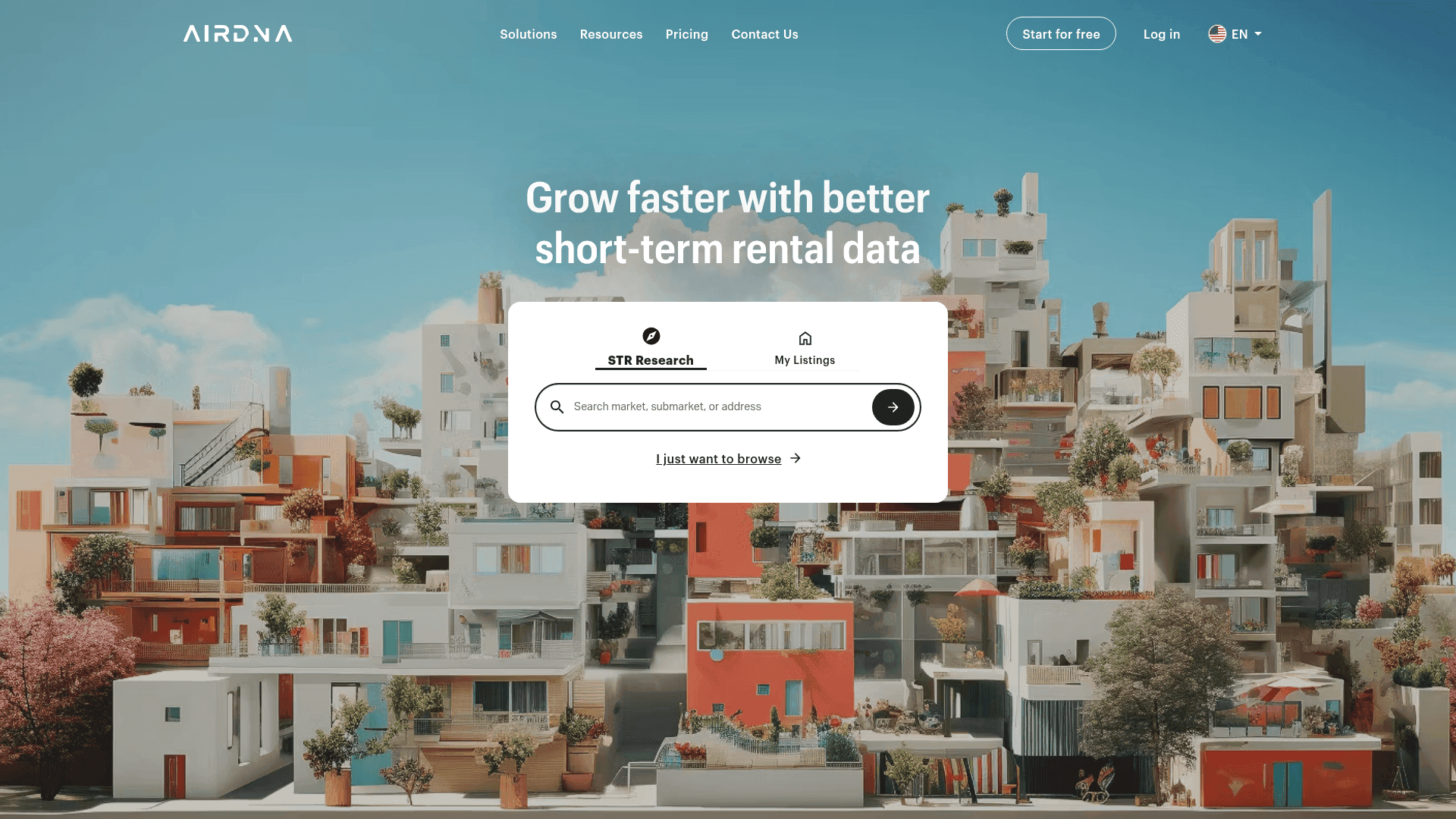
AirDNA is the analytics platform most people reach for when they want short-term rental numbers. It tracks millions of Airbnb and Vrbo listings worldwide and converts that into market-level dashboards — occupancy, average daily rate, revenue per available night, seasonality — plus property-level revenue estimates for any address you're eyeing. If you've ever wondered what a three-bedroom near a specific beach actually earns per year, this is the tool built to answer that question.
The two products you'll use most are MarketMinder and Rentalizer. MarketMinder is the market dashboard: pick a city or neighborhood and see how rates, occupancy, and revenue have trended, how supply is growing, and how the market scores as an investment. Rentalizer is the address-level calculator: type in a property and get a projected annual revenue, occupancy, and nightly rate based on comparable listings nearby. Hosts use the same data in reverse, benchmarking their own listing against comps to see whether their pricing or occupancy is lagging the street.
What AirDNA actually does
Under the hood, AirDNA scrapes and models publicly visible listing data — calendars, prices, reviews — and, for a subset of properties, blends in actual performance data shared by hosts and property managers. That mix matters: the modeled numbers are estimates, not bookings data from Airbnb's servers, and the quality of the estimate depends on how many true comps exist near the property you're analyzing.
In practice, investors use it to shortlist markets, compare neighborhoods, and sanity-check a deal's revenue assumptions before writing an offer. Lenders and analysts use its market reports; hosts use the comp sets and demand data to set prices through the year.
Key features
- MarketMinder dashboards with occupancy, ADR, revenue, and supply trends for thousands of markets
- Rentalizer address-level revenue projections built from nearby comparable listings
- Market scoring that grades areas on investability, demand, and regulation risk
- Comp sets and benchmarking so hosts can measure their listing against neighbors
- Historical data and exports on higher tiers, for underwriting and reporting
Pricing
AirDNA is a subscription, and despite what older directory listings say, it isn't free — only limited teaser data is. Plans are priced by market size: researching a small town costs little, while dense markets and multi-market access push you into pricier tiers, with custom pricing for enterprise and API access. The structure and plan names have shifted several times in recent years, so check the live pricing page rather than trusting any review's quoted numbers, including ours.
Who it's for
Buyers evaluating their first or fifth short-term rental get the most from it — a Rentalizer projection plus a MarketMinder trend line is a fast, cheap sanity check before you underwrite a deal. Existing hosts benefit from benchmarking, and analysts or lenders who need market-level STR data will find few alternatives with this coverage.
Our take
We consider AirDNA the default choice in this category for a reason: nothing else matches its breadth of markets and depth of history at a price an individual investor can justify. Used for comparing markets and spotting trends, the data is genuinely good, and the interface makes a complicated dataset easy to interrogate.
Our warning is about false precision. Rentalizer outputs a confident-looking annual revenue figure, but it's a model built on scraped comps — in thin markets, or for unusual properties, it can miss badly, and hosts routinely report earning meaningfully more or less than projected. Blocked calendars, owner stays, and amateurishly run comps all muddy the inputs. Treat the estimate as the midpoint of a wide range, haircut it before it goes into your mortgage math, and cross-check against two or three real listings' calendars. As a directional tool it's excellent; as a guarantee it's a trap.