You.com provides AI search and research assistance. It is useful when a question needs current web information and a conversational way to explore the…
AI Search ToolsSee website
Algolia adds AI search to websites and apps using your indexed records, with discovery controls, analytics and conversational knowledge answers.
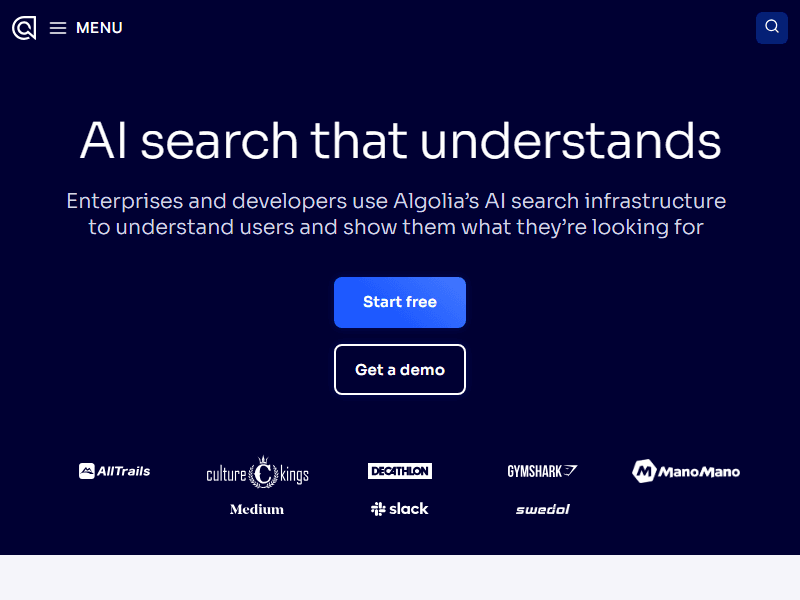
Algolia is a search and discovery platform for adding searchable content to a website or application. A team supplies its own product catalog, documents or other records, then uses Algolia's search services and interface tools to help visitors find the relevant items. It is a particularly relevant option for ecommerce search, documentation search and applications where browsing a large collection has become difficult.
The platform includes AI search capabilities as well as tools for controlling results, analyzing searches and presenting recommendations. Its conversational Ask AI product adds an answer-oriented experience to indexed content. These features serve related but different purposes: a product search returns useful items to compare, while a documentation answer explains a subject using the available source material.
Algolia works on the content provided to the implementation. It does not automatically become a general search engine for the public internet. The quality of the records, the way the interface is designed and the criteria used to evaluate results all affect the usefulness of the search experience.
Algolia's AI Search combines keyword-oriented retrieval with semantic capabilities that can help interpret a user's intent. This is useful when the vocabulary in a query differs from the wording in the indexed records. A customer may describe the purpose of a product rather than know its exact catalog name, and a documentation reader may ask about a task instead of a page title.
Evaluate that behavior with queries drawn from real use. An ecommerce team might include an exact product name, a category name, a common misspelling and a description of the intended use. A documentation team might include a feature name, an error message and a plain-language question. Those query types expose different requirements and should not be judged as if they were identical.
Define what a useful result means before adjusting the search. For an exact product identifier, the matching item should be easy to find. For a broad category query, the results should offer a sensible range of relevant choices. For a support task, the result should take the reader to the instructions that address the task, with enough context to choose the right page.
Semantic matching does not remove the need for accurate content. If a product record lacks an important attribute, the search has less information to work with. If documentation uses outdated feature names, the results may lead the reader toward an obsolete explanation. Better retrieval and better records should be developed together.
Before adding a collection to Algolia, decide what each searchable record represents. In a store, the team needs to determine whether a record represents a product or a particular variant. In a documentation site, the useful unit may be a page or a section. That decision affects what appears in a result and what the user can do after selecting it.
For a product catalog, identify the fields that a shopper needs: a clear name, category, relevant attributes, destination URL and useful visual information. Where a search interface displays price or availability, the update process needs to keep those values aligned with the source system. A well-ranked product is still a poor result if the displayed information is stale.
Keep terminology consistent across related records. If one product uses “navy” and another uses “dark blue” for the same attribute, decide how the catalog and filters should present that distinction. The aim is not to force every description into identical language, but to make structured attributes reliable enough for searching and narrowing results.
Plan how records change over time. New items need to enter the index, updated content needs to replace older versions and removed items should stop appearing where appropriate. Assign responsibility for that process during implementation. Search quality is easier to maintain when record freshness has an owner rather than being treated as a one-time import.
Consider a store selling tableware, textiles and storage products. Its customers search for exact items, but they also ask broader questions such as which bowls suit a small kitchen. The implementation can begin with a representative part of the catalog in Algolia, including the attributes that distinguish those products.
The first evaluation should check whether an exact product query returns the correct item clearly. The next should examine category queries and descriptions of use. A result page can then help shoppers narrow the collection by meaningful attributes, provided those attributes are present and consistent in the catalog. Filters should reflect genuine choices in the inventory, rather than a long list of values that produce empty results.
Review the information shown on each product result. A shopper may need the material, dimensions or pack size to distinguish similar items. If the card shows only a shortened title and a picture, several relevant products may look interchangeable. Search relevance and result presentation need to work together so the visitor can make a decision.
After the initial rollout, examine searches that produce no useful result. Some may reveal an indexing problem; others may show that customers use different words from the catalog. A few may represent products the store does not sell. Treat these as different issues. This suggested workflow shows how Algolia can support product discovery without assuming that every failed query needs a ranking adjustment.
Algolia provides controls for influencing search results and merchandising. These are useful when the search experience needs to reflect a business context, such as a seasonal collection or a curated category. Apply those controls with an understanding of the query. A promoted item should still make sense to someone looking for the product described in the search.
Separate relevance decisions from presentation decisions during evaluation. If the correct item is present but difficult to recognize, the card or snippet may need work. If the item is absent, inspect the indexed content and retrieval behavior. If a business rule moves an unrelated product above useful matches, review that rule. This distinction makes it easier to correct the actual cause.
Use filters to help the visitor make a meaningful choice. A technical documentation site might need product version or content type. An ecommerce site might need size, material or price range. The right filters depend on the collection and the task. An implementation should test both a broad query and a narrowed query so the filtered results remain useful.
Keep a small set of representative queries when changing rules. Run those queries before and after the change and review the effect on the first results. A rule that helps one campaign can inadvertently weaken a common product search. A repeatable query set gives the team a practical way to notice that tradeoff before it becomes a widespread issue.
Algolia's Ask AI is a conversational layer for technical documentation, help content and other indexed knowledge. It supports natural-language questions, follow-up interactions and answers with citations. It can work with DocSearch or a custom interface, and its documentation describes connecting an LLM provider using the implementer's own API key.
This workflow is useful when the reader needs an explanation assembled from the documentation, rather than just a list of links. For example, a developer may ask which setup steps apply to an existing application. A cited answer can point to the source pages used in the response, giving the reader a route to inspect the detailed instructions.
Prepare the documentation for that kind of retrieval. Write clear headings, separate current instructions from legacy behavior and keep examples close to the explanations they support. Where a feature differs by version, make the version explicit. The answering layer has a better foundation when the source content expresses those distinctions clearly.
Evaluate questions that have an answer, questions that require context and questions the content does not answer. Check whether the citations support the response and whether a follow-up question preserves the relevant context. If the documentation lacks the answer, update the source material rather than expecting a conversational interface to supply a reliable missing fact.
Algolia includes search analytics to help teams understand how visitors use the experience. The useful starting questions are concrete: what people search for, which searches fail to produce useful results and what users do after receiving results. Review those patterns alongside the indexed content and the design of the result page.
For an online store, a click can indicate that a result attracted attention, but it does not establish that the product met the shopper's need. Where the implementation supports the relevant measurement, consider the later steps in the journey as well. A strong search experience should help the visitor move toward the intended action without obscuring useful alternatives.
For documentation, examine whether readers reach the relevant explanation and whether recurring questions remain unanswered. A popular query with an unhelpful result may point to a missing page or a poorly named section. Improving that content can be more useful than adjusting a search setting that cannot compensate for the missing explanation.
Assign a regular review cycle to the search experience. Catalog changes, product launches and documentation updates alter what visitors need. Keep the query evaluation set current, record meaningful configuration changes and review the effects. Algolia provides the search platform, while the team maintaining the collection supplies the context needed to improve it.
Algolia provides APIs, documentation and interface libraries for connecting search to an application. The required development effort depends on the existing stack, the source of the records and the desired user experience. A prebuilt integration may cover part of the work, while a custom application needs its own indexing and interface decisions.
Start with an implementation that exposes the core task clearly. The search field should have an understandable label, results should identify the destination and the empty state should explain what the user can try next. Test the interaction on mobile as well as desktop, especially where filters and result details compete for limited screen space.
Before a production rollout, test the complete path from a changed source record to the displayed result. Verify the destination link and any information shown in the search card. This catches problems that are invisible when testing only the search response. Use the current Algolia documentation for implementation details and feature-specific requirements.
Algolia offers a free development allowance and paid plans whose costs depend on the products and usage selected. Search requests, indexed records and additional capabilities can affect the plan needed for an implementation. AI and recommendation features should be checked separately instead of assuming every capability is included in the entry-level allowance.
Estimate usage from the actual interface and collection. A busy search box, an autocomplete experience and a large product catalog create different demands. Review the current Algolia pricing page and monitor the relevant account usage during a pilot. Include any connected LLM cost when evaluating an Ask AI implementation that uses your own provider.
Algolia is relevant to product and development teams that need managed search across a substantial collection of their own content. It is especially useful to evaluate when the current search struggles with discovery, result controls or an expanding catalog. Successful adoption requires attention to the records, the interface and the ongoing maintenance process.
For a knowledge-answering project, CustomGPT.ai offers a more focused chatbot route. Dify and Flowise support broader AI application workflows. They address adjacent needs and are not direct replacements for every Algolia product-search feature. Compare the result experience you need to build.
Algolia searches the records supplied to the implementation. The team needs to connect or import the relevant content and maintain its updates. It is not automatically a public-web search engine.
Ask AI provides a conversational experience over indexed content, including documentation and help material. Evaluate the answers and their citations against your source content before rollout.
A free development allowance is available. Production requirements and additional features may need a paid plan. Check the current usage and feature terms for the implementation you intend to build.
Most custom implementations involve development work for indexing and interface integration. The effort depends on the source system and any supported integration already available for it.