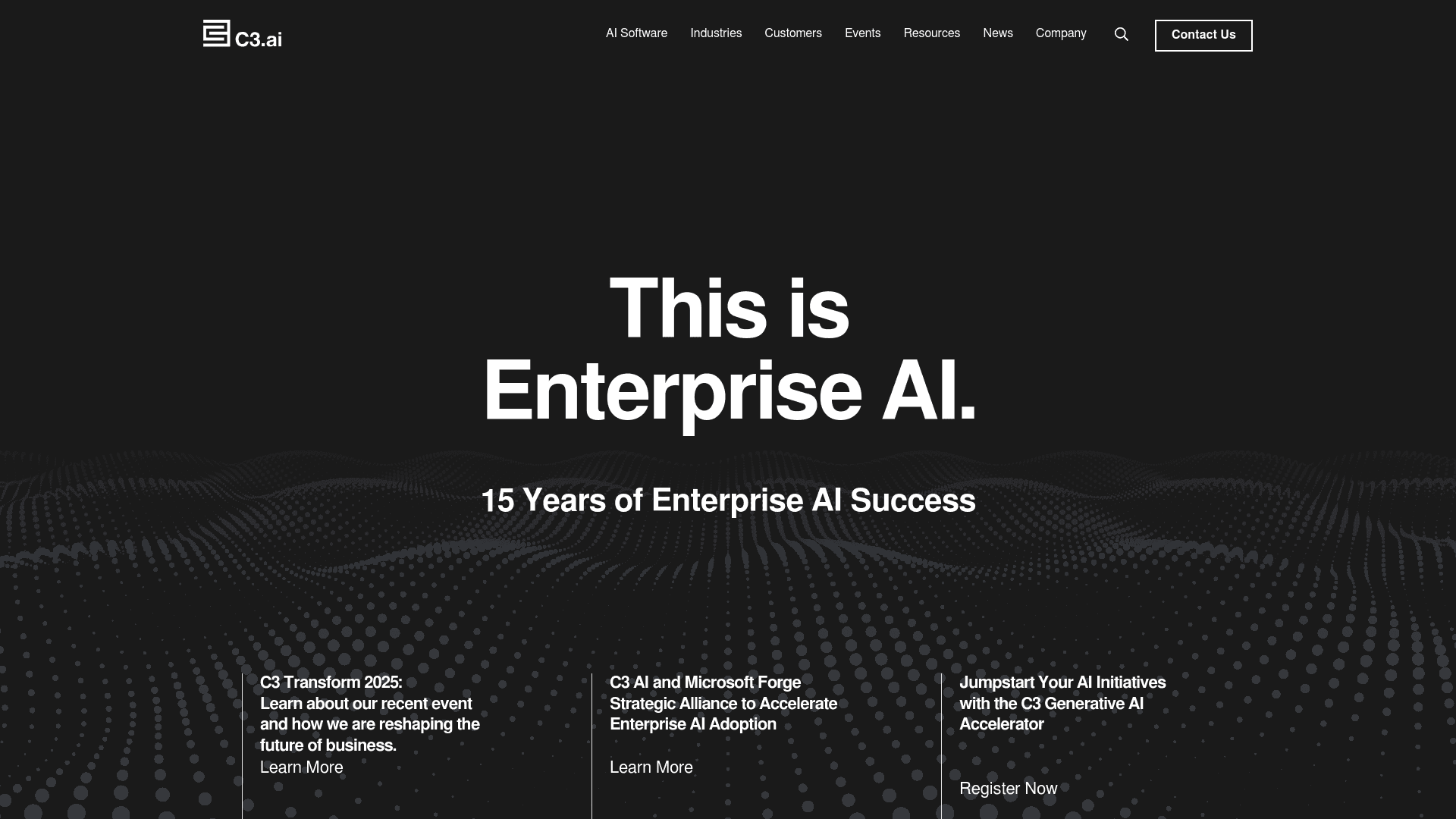
C3 AI is an enterprise software company that sells a platform for building and running AI applications at large organizations, along with a catalog of prebuilt apps for jobs like predictive maintenance, supply chain optimization, fraud detection, and anti-money laundering. Founded by Silicon Valley veteran Tom Siebel in 2009 and listed on the NYSE under the pointed ticker AI, it shows up in finance tool lists because banks use it for AML and risk work, but its customer base spans energy, manufacturing, defense, and government.
Anyone evaluating C3 AI in 2026 should know the company is going through a genuinely turbulent stretch. Siebel stepped back from the CEO role in 2025 for health reasons, former Salesforce executive Stephen Ehikian took over, and in May 2026 Siebel returned as CEO with Ehikian staying on as president. Fiscal 2026 revenue came in around $250 million, down sharply from the prior year, alongside heavy losses and a restructuring aimed at roughly $135 million in annualized cost savings. None of that means the technology stopped working, but it belongs in any buying decision.
What the platform actually does
The C3 Agentic AI Platform is a development and runtime layer that sits on your cloud of choice. In practice it covers three things:
- Data unification, stitching together sensor feeds, ERP records, and operational databases into one model of the business, which is usually the hardest 80 percent of any enterprise AI project.
- Model development and operations, so data science teams can train, deploy, and monitor models against that unified data.
- Prebuilt and agentic applications, dozens of packaged apps that ship with domain logic, from equipment-failure prediction to money-laundering alert triage, which teams configure rather than build from scratch.
A strategic alliance with Microsoft, announced in late 2024, made Azure a major sales channel, and reference customers have included Shell and the US Air Force.
Who it's for
C3 AI is for large enterprises and government agencies with sprawling data estates, real budgets, and executive sponsorship. A bank's financial crime team or a utility's operations group is the archetypal buyer. It is emphatically not for startups, individual analysts, or anyone hoping to self-serve; despite what some directories claim, there's no meaningful free product, just enterprise contracts and pilot engagements.
Our take
We give C3 AI credit for being early to a thesis the market later adopted: that enterprises want packaged AI applications tied to business outcomes, not raw tooling. Its deployments at the scale of national defense and global energy are real, the Microsoft channel lowers adoption friction, and the pivot toward agentic applications matches where enterprise demand is heading.
But we'd counsel real caution right now. Revenue falling that fast, leadership changing twice in a year, and deep losses add up to vendor risk you must price in for a platform designed to sit at the center of your operations; a multi-year commitment deserves contractual protections and a hard look at the company's trajectory. Implementations also lean heavily on services and take quarters, not weeks, and the hyperscalers' native AI stacks keep absorbing more of what once made platforms like this distinctive. If your need is finance-specific, dedicated AML or fraud vendors may get you live faster with less concentration risk.