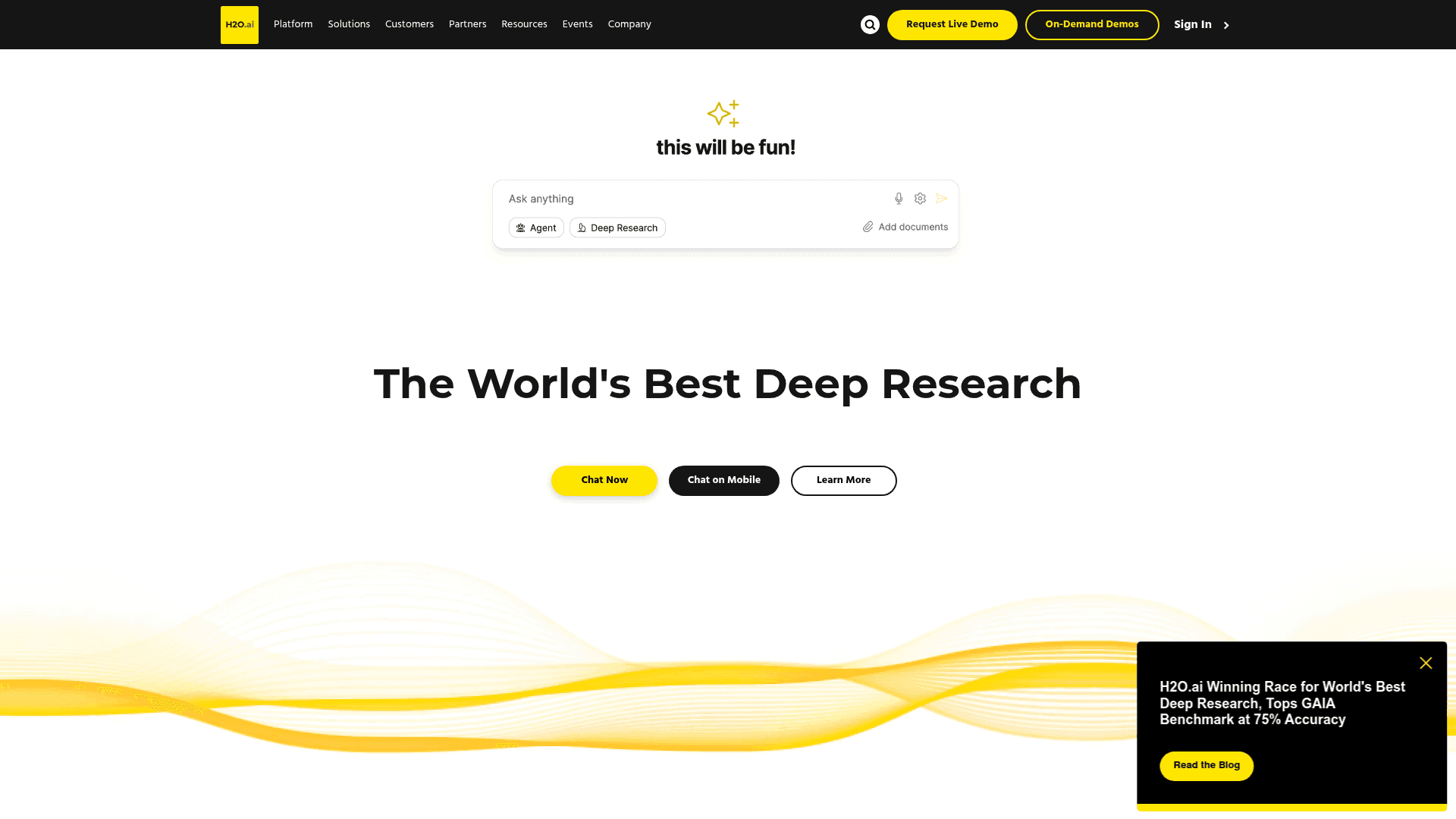
H2O.ai is a machine learning company with two distinct audiences. Data scientists know it for H2O-3, the open-source framework that has been training models on large tabular datasets since the early 2010s. Enterprises know it for the paid platforms built on top: Driverless AI, which automates most of the model-building pipeline, and h2oGPTe, its generative AI product for running document Q&A and AI agents on private data.
It shows up in a lot of finance tool directories because banks and insurers are among its heaviest users — credit scoring, fraud detection, and claims models are classic H2O workloads — but nothing about the platform is finance-specific. Retailers use the same tooling for demand forecasting and hospitals for readmission risk.
What H2O.ai actually does
Driverless AI is the flagship. Point it at a dataset, tell it what you want to predict, and it handles feature engineering, algorithm selection, hyperparameter tuning, and validation on its own. It then generates documentation explaining how the model behaves — which matters in regulated industries, where an unexplainable model is a non-starter with auditors. Work that once took a data science team weeks compresses into hours.
h2oGPTe is the newer generative side: retrieval-augmented chat over your own documents, plus agentic features added through 2025 that chain multi-step tasks together. The pitch is privacy. Everything can run inside your own infrastructure, including fully air-gapped environments, which is why H2O.ai markets hard to governments and banks under its sovereign AI banner. Gartner named the company a Visionary in its 2026 Magic Quadrant for data science and machine learning platforms.
Key features
- H2O-3, the free open-source ML framework with Python and R interfaces
- Driverless AI for automated feature engineering, model tuning, and validation
- Machine learning interpretability tools that explain predictions for auditors and regulators
- h2oGPTe for private retrieval-augmented generation and AI agents
- Hydrogen Torch for deep learning on images, audio, video, and text
- Flexible deployment on any cloud, on-premises, or air-gapped
Who it's for
Teams with genuine data science workloads and genuine compliance constraints. The open-source tools suit individual practitioners and students; the enterprise platforms are aimed at organizations that need model documentation, private deployment, and vendor support. If you just want to analyze a spreadsheet, this is far more machinery than you need.
Pricing
H2O-3 is free and open source. Driverless AI and h2oGPTe are quote-based enterprise products — H2O.ai doesn't publish list prices, and you'll go through a sales process to get numbers. Trials are available through the company's cloud environment.
Our take
We rate H2O.ai's core technology highly. The AutoML in Driverless AI is genuinely good, the interpretability tooling is ahead of what most rivals bundle in, and the ability to run everything — including generative AI — entirely inside your own walls is a real differentiator now that data residency questions kill so many AI projects. The open-source lineage also means plenty of practitioners already know the tools.
Our gripes are about packaging rather than capability. The product lineup is confusing — H2O-3, Driverless AI, h2oGPTe, Hydrogen Torch, and an AI Cloud umbrella overlap in ways the website doesn't explain well — and opaque enterprise pricing makes budgeting hard until you're deep in a sales cycle. The open-source community edition also gets noticeably less attention than it once did as the company chases enterprise generative AI deals.