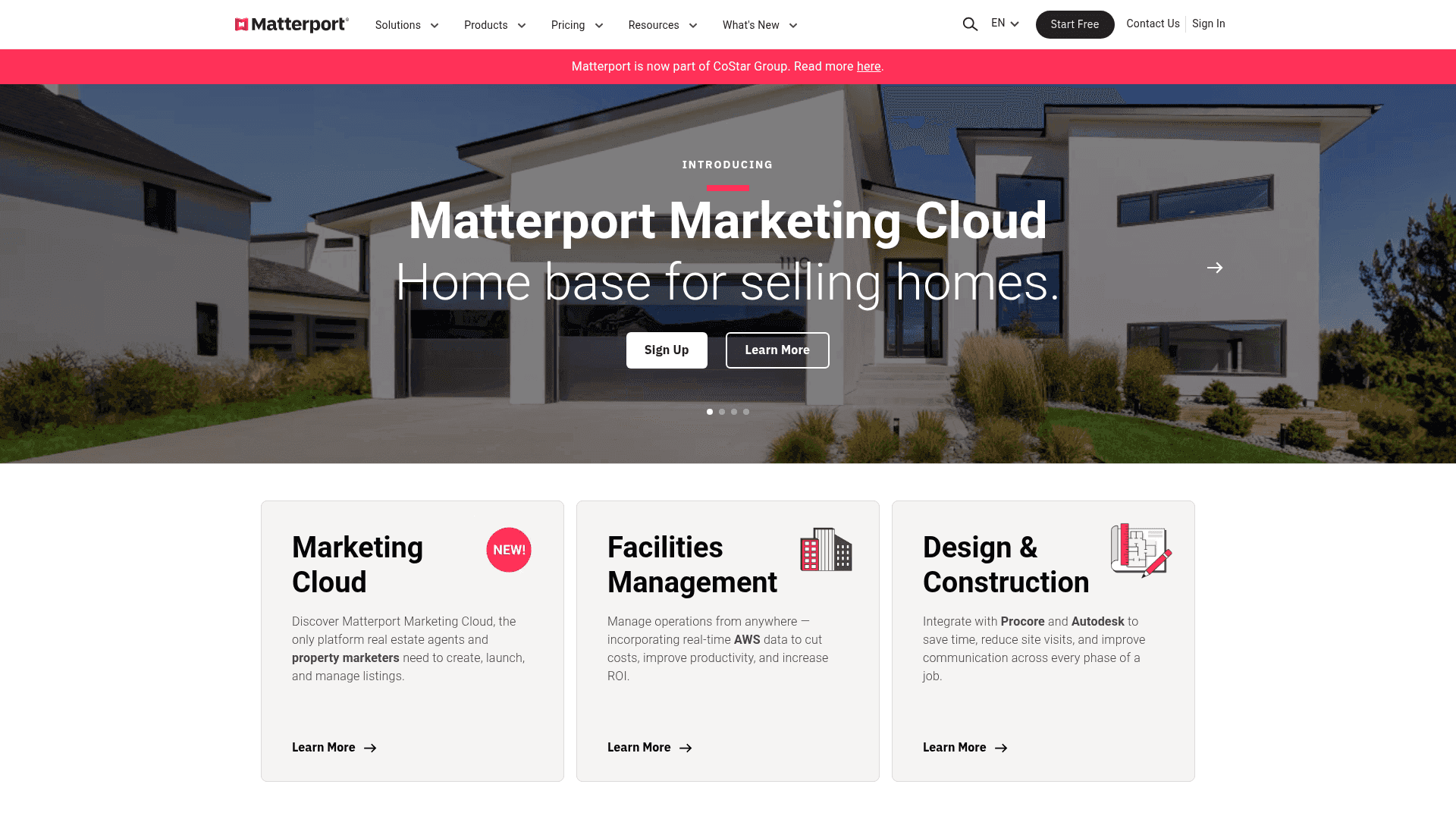
Matterport is the company most people mean when they say '3D tour.' You scan a home or building with a camera, the software stitches the scans into an interactive model, and anyone with the link can walk through the space room by room, spin the signature dollhouse view, or pull up a floor plan. For real estate listings it has become the default way to let buyers tour a property without driving there.
The company is no longer independent. CoStar Group — the firm behind Homes.com, Apartments.com, and LoopNet — completed its acquisition of Matterport in February 2025 in a cash-and-stock deal valued around $1.6 billion. Matterport still operates under its own name, and its tours are being pushed hard across CoStar's listing sites.
What Matterport actually does
Capture works three ways: Matterport's own Pro-series cameras (the LiDAR-equipped Pro3 is the current flagship), supported third-party 360 cameras, or the free smartphone app. You walk the space, scanning from a series of points; the cloud service processes the scans into a navigable 3D model, called a digital twin. From there you can generate schematic floor plans, take measurements directly inside the model, add tags with notes or video, and embed the tour on a listing page or website.
The AI side has grown well beyond stitching. Property Intelligence features pull automatic room dimensions and layouts from a scan, and the defurnishing tool digitally empties a cluttered room so buyers can see the space itself — cheaper than staging, if less charming.
Key features
- 3D walkthroughs — smooth room-to-room navigation plus the dollhouse and floor-plan views.
- Flexible capture — Pro3/Pro2 cameras, supported 360 cameras, or an iPhone/Android app.
- Measurement mode — measure walls, doorways, and furniture clearances inside the tour.
- Schematic floor plans — order 2D plans generated from a completed scan.
- AI tools — automatic dimensions and digital defurnishing of scanned rooms.
- Embeds and integrations — tours embed in MLS listings, Zillow, Homes.com, and brokerage sites.
Who it's for
Residential agents and the photographers who serve them are the obvious audience, but the commercial side is arguably stickier: property managers document units at move-in and move-out, facilities teams keep a browsable twin of every building, insurers and restoration firms use scans as condition records, and architects scan existing spaces before renovation work.
Pricing
There's a free tier for a single active space, captured by phone, which is a fair way to test the workflow. Paid plans are priced by the number of active spaces you host, and the cameras are a separate cost — the Pro3 runs several thousand dollars. A busy listing photographer will also outgrow the lower tiers quickly.
Our take
Matterport remains the standard for a reason. The capture-to-published-tour pipeline is genuinely easy, the model quality with a Pro3 is excellent, and buyers actually use the tours — agents we've talked to consistently say 3D-toured listings generate better-qualified showings. The smartphone capture path is rougher around the edges but fine for a rental unit or a quick condition record.
Two things to weigh before committing. First, the per-active-space subscription model means costs scale with your library, and archiving a tour to save money makes it unavailable — effectively, your tours live on Matterport's cloud and stop working if you stop paying. Second, the CoStar acquisition cuts both ways: distribution across Homes.com and Apartments.com is a plus, but Matterport is now owned by a company that competes directly with Zillow and some brokerages, and long-term neutrality is no longer guaranteed. If either bothers you, look at Zillow 3D Home, iGuide, or CloudPano before you build a big library here.