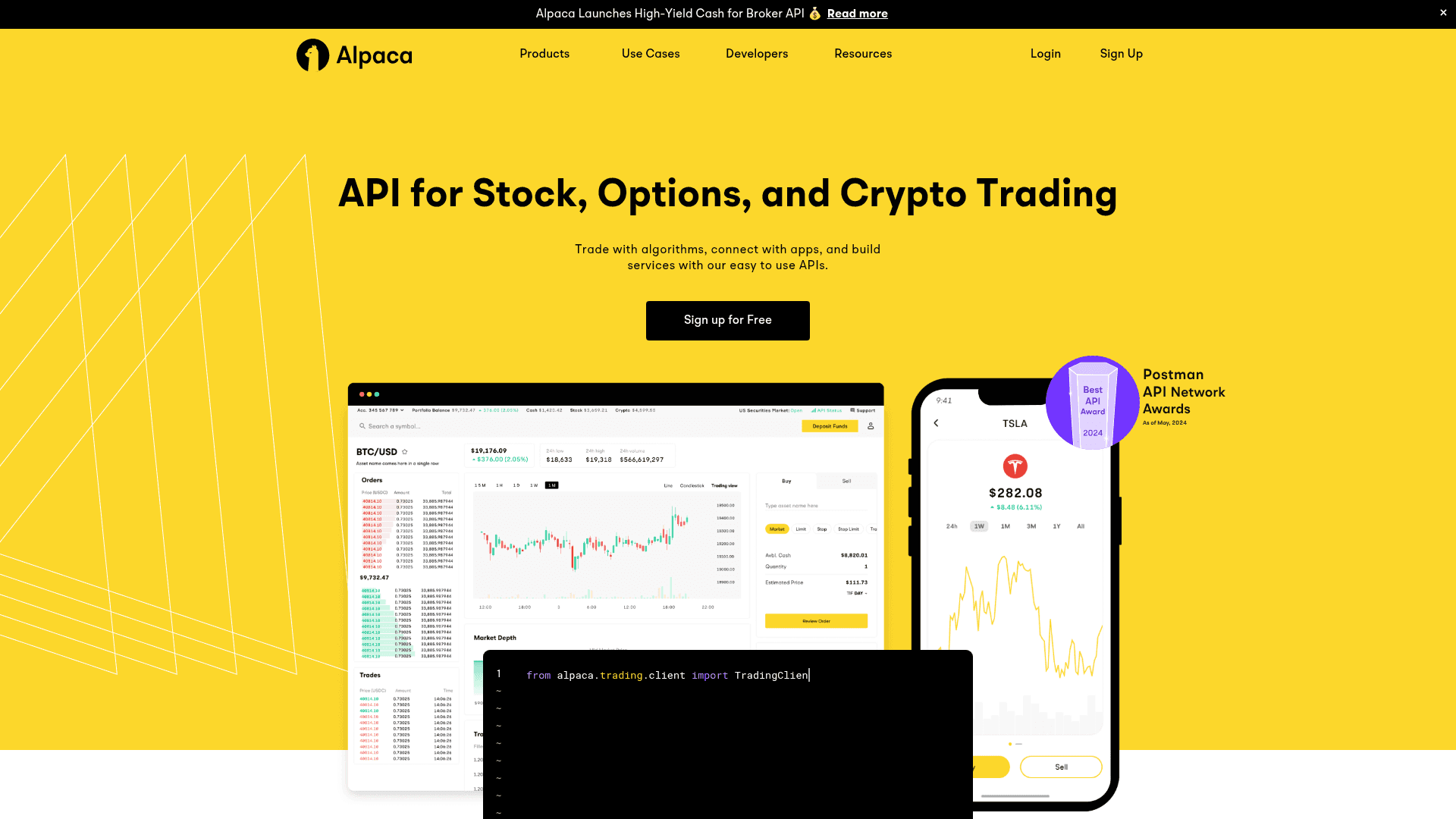
Alpaca is a brokerage you talk to through code. Its APIs let you place commission-free trades in US stocks, ETFs, options, and crypto from a Python script, a trading bot, or an app you're building, and a paper trading environment mirrors the whole thing with fake money so you can test strategies before risking real ones. There's a web dashboard, but it's deliberately minimal; the API is the product.
Two distinct audiences use it. Individual developers and quants connect the Trading API to run their own strategies. Fintech companies use the separate Broker API to embed brokerage accounts inside their own apps, which is how Alpaca powers investing features in products around the world.
The company has real momentum in 2026: a $150 million Series D early in the year, then another $135 million in July led by Peak XV as part of a package that included roughly $300 million in debt financing. The current push is tokenized assets and infrastructure for AI trading agents, and Alpaca says API trading volume quadrupled in early 2026.
Key features
- Commission-free trading of US stocks and ETFs, with options and crypto also available (crypto pricing includes a spread, so it isn't quite free).
- Fractional shares, so a bot can buy $5 of a $900 stock without special handling.
- Paper trading that uses the same API as live trading; flip an endpoint and your bot goes from simulation to production.
- Market data API with a free tier and paid subscriptions for full-market, real-time feeds.
- Broker API for building your own investing product, with account opening, funding, and compliance handled by Alpaca.
- Official SDKs for Python, JavaScript, Go, and C#, plus OAuth so third-party tools can connect to user accounts.
Who it's for
Alpaca fits developers who want to automate trading, students learning quant finance on the free paper environment, and founders who need brokerage infrastructure without becoming a broker-dealer themselves. It is a poor fit if you want a rich retail experience: there are no advanced charts, screeners, or research reports, and that's by design. If you never plan to write code or use a tool built on Alpaca, a conventional broker will serve you better.
Pricing
Trading US stocks and ETFs costs nothing in commissions, and paper trading is free with no account funding required. The meaningful costs are market data, where the free feed covers only a slice of market activity and serious strategies need a paid real-time subscription, and the Broker API, which is priced per use for businesses. Regulatory fees on sales still apply, as they do everywhere.
Our take
We think Alpaca is the most approachable way to put real trades behind your own code. The documentation is genuinely good, the paper-to-live workflow is exactly right, and the free tier means a student can build and test a full strategy without spending a dollar. The fresh funding also eases the counterparty worry that hangs over smaller fintechs.
The annoyances are real, though. The free market data feed comes from a single exchange's slice of volume, which can mislead a backtest until you pay up for the full feed. Support response times draw regular complaints, and occasional API hiccups matter more when a bot, not a human, is doing the trading. And the current emphasis on tokenization and AI agents, while interesting, means the roadmap is chasing newer markets while some longstanding developer requests wait. Test with paper trading, budget for data, and keep your own kill switch.