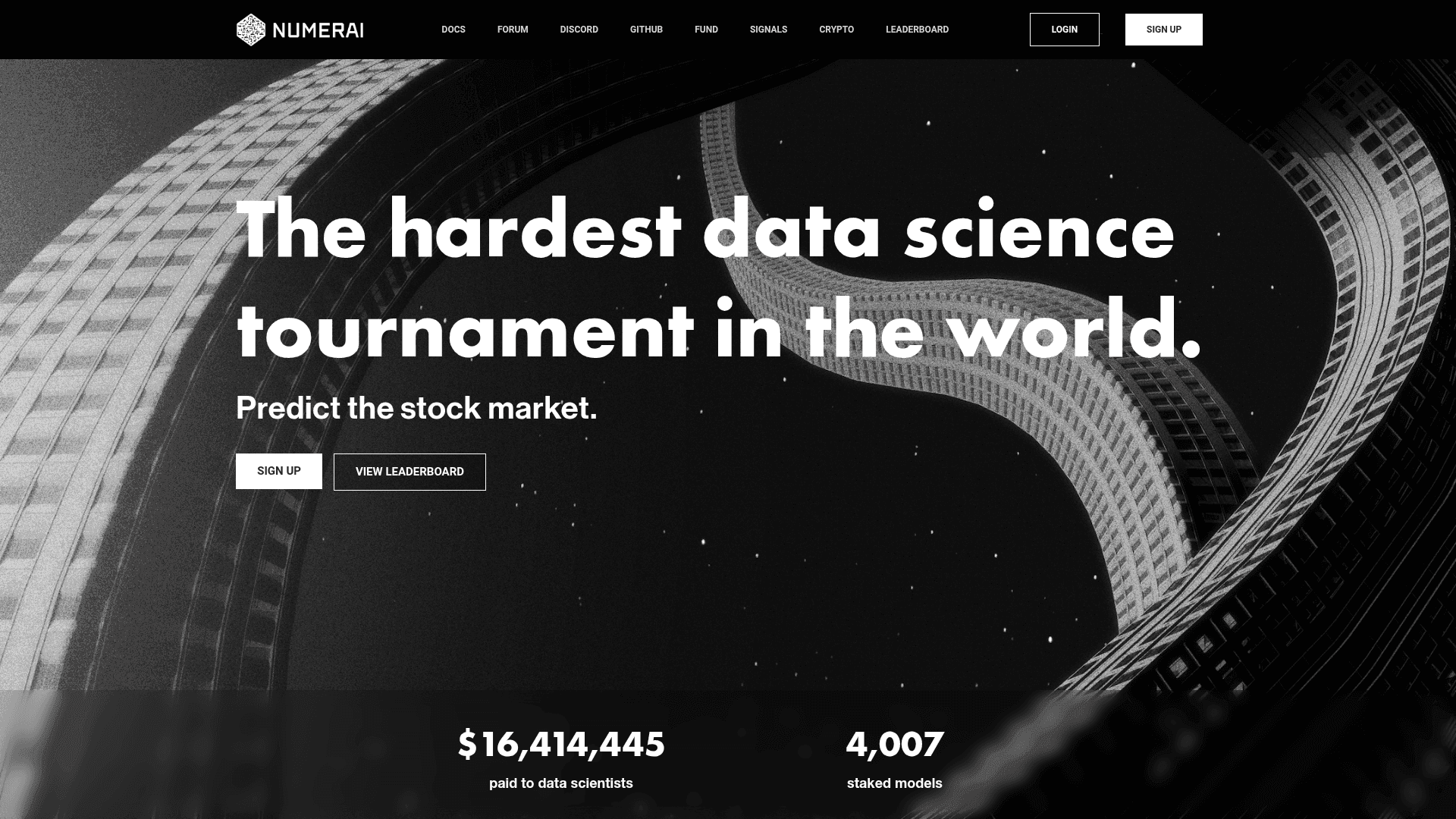
Numerai is a hedge fund that outsources its brain. Founded in San Francisco in 2015 by Richard Craib, it runs a continuous data science tournament: anyone can download its free, obfuscated financial datasets, train a model, and submit predictions about relative stock performance. Numerai combines the best submissions into a meta-model that drives a market-neutral global equity fund. Participants put skin in the game by staking Numeraire (NMR), the project's cryptocurrency, on their own predictions; accurate models earn more NMR, and bad ones get a slice of their stake burned.
For years the fair question was whether this elegant design actually made money. As of 2026 the answer looks like yes. The flagship fund returned about 25 percent in 2024 after a painful 2023, and in May 2026 JPMorgan Asset Management committed up to $500 million, an allocation set to push assets toward $1 billion. The company also raised a $30 million Series C at a $500 million valuation. A crowdsourced fund with a top-tier institutional backer is no longer a curiosity.
How the tournament works
- Download the data. Numerai provides clean, feature-engineered tabular data. The features are obfuscated, so you don't know which column is which real-world signal; you need no finance knowledge, just modeling skill.
- Train and submit. Build a model, generate predictions, and upload them on the regular round schedule. Most participants automate this.
- Stake NMR. Payouts scale with your stake and your model's performance on metrics like correlation with realized returns and unique contribution to the meta-model. Underperform and part of your stake is destroyed.
A second competition, Numerai Signals, flips the setup: you bring your own data on real, named stocks and submit ranking signals, which suits people who already have a proprietary edge.
Who it's for
The tournament is for data scientists and machine learning engineers who want a live, adversarial benchmark with real money attached; plenty participate as a serious hobby alongside a day job. The fund itself is a separate matter, open to institutions and qualified investors, not something you buy into from the website. If you're neither a modeler nor an institution, Numerai is fascinating to watch but not a product for you.
Costs and rewards
Participation is free: data, submissions, and evaluation cost nothing. The real economics live in the staking. Rewards are paid in NMR, so your upside compounds crypto price risk on top of model risk, and burns are not theoretical; mediocre models lose money steadily. Nobody should stake funds they can't afford to see shrink.
Our take
We think Numerai has the most interesting incentive design in quantitative finance. Obfuscated data means the crowd competes on modeling skill rather than data access, staking filters out noise from tourists, and the JPMorgan allocation is the strongest external validation a structure like this could get. As a way for a machine learning practitioner to test themselves against a real market, nothing else quite compares.
Being honest about the drawbacks: most participants earn modest amounts relative to the effort, and the grind of keeping models submitted every round is a part-time job. Payout rules and scoring metrics have been revised repeatedly over the years, which can suddenly disadvantage a previously fine model, and the NMR denomination means a winning season can still lose dollar value. Join for the intellectual sport and the community first; treat any income as a bonus, not a plan.