Turn business files into structured data and controlled workflows with fileForge, fileLedger and fileShield.
FormX
FormX extracts structured data from documents such as receipts and invoices. Use its document workflows and API to move reviewed fields into your business systems.
OCR AI ToolsFreemium
formx.ai
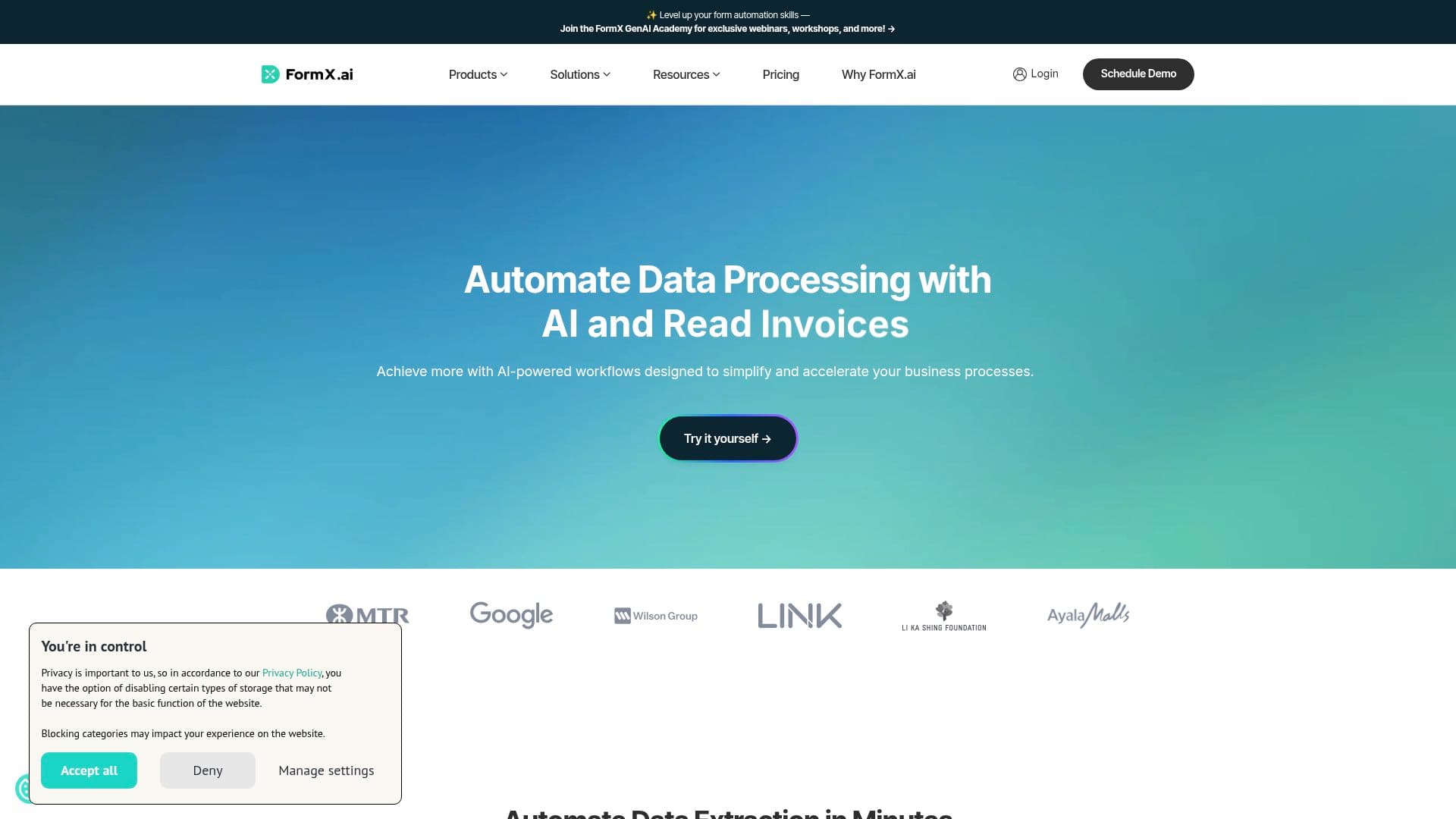
FormX.ai is an intelligent document processing (IDP) platform that turns paper and PDF documents into structured, machine-readable data. Built by Oursky, a Hong Kong software studio founded in 2008, it targets the tedious middle layer of business admin: someone receives a receipt, an invoice, an ID card, or a bank statement, and the numbers on it need to end up in a system somewhere. FormX reads the document and returns the fields — dates, amounts, vendor names, ID numbers — as clean JSON.
The pitch is speed to value. Instead of training an OCR model from scratch, you pick a pre-built extractor for common document types, or configure a custom one through the web portal without writing code. Developers then wire it into their product through a straightforward REST API, and there's a mobile scanning app for capturing documents in the field.
What FormX.ai actually does
At its core, FormX combines OCR with machine-learning models that understand document structure. Point it at a stack of supplier invoices and it identifies the invoice number, line items, totals, and tax amounts — regardless of each supplier's layout. The platform ships extractors for receipts, invoices, purchase orders, ID cards, passports, bank statements, business registrations, and licenses, which covers most of what a typical finance or onboarding team handles.
Two example uses from real deployments: an accounting firm scans client receipts and lets FormX pull dates, amounts, and vendor details straight into its bookkeeping system, and banks use the ID and passport extractors to speed up customer onboarding and KYC checks. Recent updates have added bounding-box coordinates in extraction results (so you can see exactly where on the page a value came from) and options to run extraction through large language models for harder documents.
Key features
- Pre-built extractors for receipts, invoices, IDs, passports, and bank statements
- Custom extractors configured through a no-code web portal
- REST API for integrating extraction into your own product or workflow
- Mobile scanning app for field capture
- Multi-language document support, including strong coverage of Asian formats
- Bounding-box coordinates and confidence data for verifying results
Pricing
FormX runs a freemium model: you can sign up and test extraction on a limited number of documents at no cost, then move to paid plans priced by document volume, with enterprise tiers for higher volumes and custom requirements. Exact numbers change, so check the current pricing page — but expect per-document economics, which is standard for this category.
Who it's for
Teams that process a steady stream of semi-structured documents and have (or can borrow) a developer to wire up the API: accounting and bookkeeping firms, fintechs doing KYC, logistics companies drowning in delivery notes, and product teams adding receipt capture to their apps. If your volume is a handful of documents a week, a general assistant like ChatGPT will do the job for free; FormX earns its keep at hundreds or thousands per month.
Our take
We like FormX's positioning: it's simpler and cheaper to get running than heavyweight enterprise IDP suites, and noticeably more accurate on Asian ID documents and receipts than many Western-centric rivals — no surprise given its Hong Kong roots. The portal genuinely is usable by non-developers, and the API documentation is clear enough that a first integration takes hours, not weeks.
The limitation is scale of ambition. FormX is a focused extraction service, not a full workflow platform — there are no elaborate approval chains, validation rules, or accounting-system connectors of the kind Nanonets or ABBYY offer, so you'll build that logic on your side of the API. It's also a smaller vendor, which cuts both ways: responsive support, but a thinner ecosystem and community than the big names. For straightforward extraction at reasonable volume, though, it's a solid, unflashy pick.
Similar tools
AI bookkeeping for QuickBooks Online and Xero, with bank-feed categorization, document matching, OCR, and exception review.
Finance AI ToolsPaid
Google Cloud Vision provides APIs for analyzing images and reading text.
OCR AI ToolsSee website