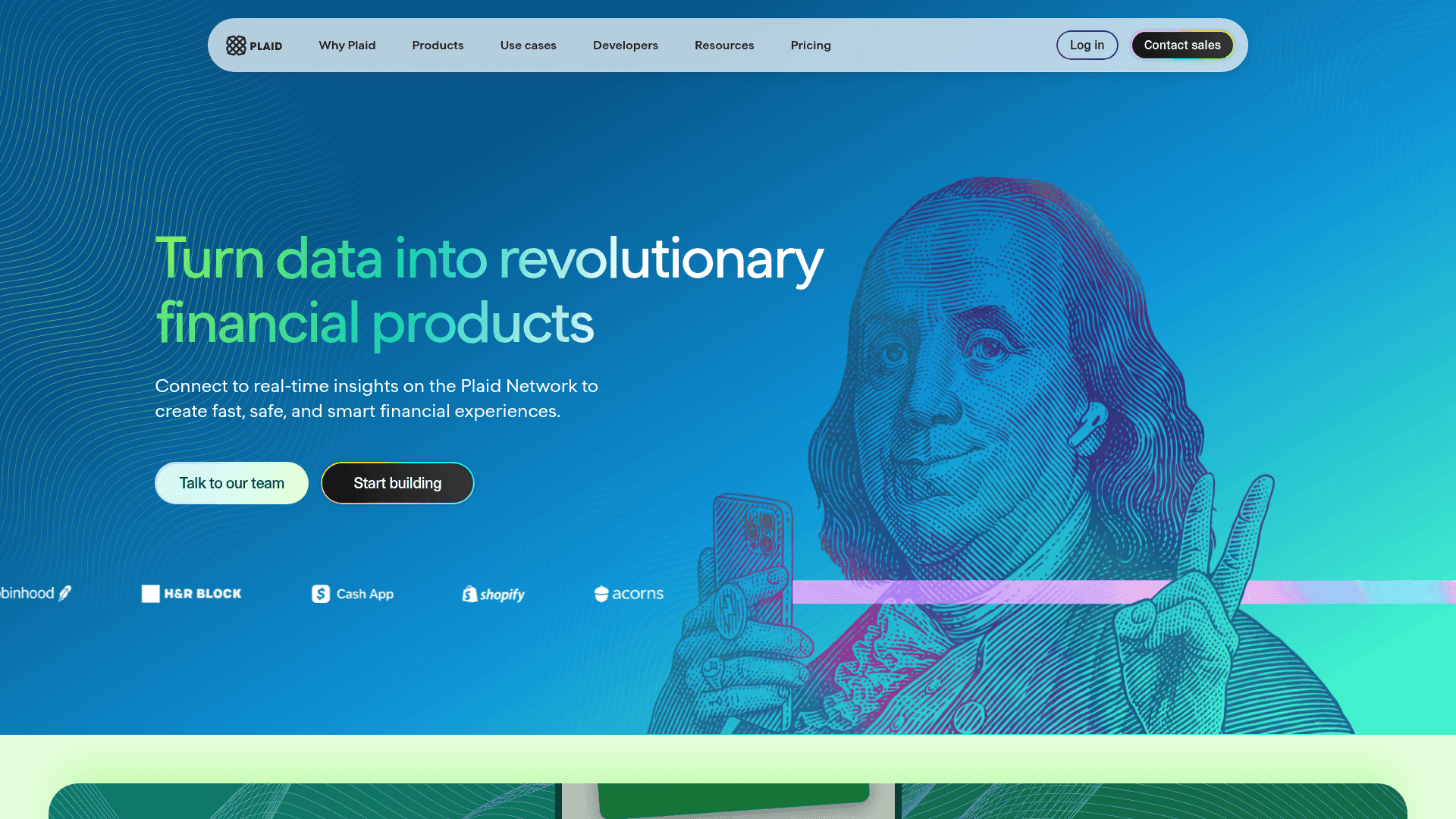
Plaid is the plumbing behind the connect your bank account button. When a budgeting app, payment service, or lender asks you to link your checking account, odds are good you're looking at Plaid Link — the company's drop-in interface that authenticates you with your bank and hands the app a secure connection to your account data. Venmo, Chime, Robinhood, and thousands of other apps run on it.
For developers, Plaid abstracts away an ugly problem: the US has thousands of banks and credit unions, each with different systems. Rather than building and maintaining thousands of integrations, you integrate Plaid once and get coverage across most of them, with the messy differences normalized into one consistent API.
What Plaid actually does
The product family maps to questions an app might ask about a user. Transactions returns categorized spending history — the backbone of every budgeting app. Auth provides account and routing numbers for setting up ACH transfers. Identity confirms the account holder matches the person signing up. Income and employment verification lets lenders and landlords confirm what someone earns straight from payroll or bank data instead of collecting pay stubs.
Crucially, the linking flow means users enter bank credentials with their bank, not with the app — the app receives tokens, never passwords. Plaid has also pushed banks toward API-based connections rather than screen scraping, which makes links more reliable and easier to revoke.
Key features
- Plaid Link, a pre-built account-connection flow developers embed in minutes
- Transactions and balance data, cleaned and categorized across institutions
- Auth, Identity, and Income products for payments setup and verification
- Fraud and credit risk tools, the fastest-growing part of the business
- Payments facilitation for bank-based transfers
- Free sandbox with pay-as-you-go and volume pricing in production
Where Plaid is headed
The company's trajectory says a lot about fintech generally. Visa tried to buy Plaid for $5.3 billion in 2020, and the deal collapsed in early 2021 after the US Justice Department sued to block it. That turned out fine for Plaid: it was valued at $8 billion in early 2026, has expanded well beyond data access into fraud detection, credit risk analytics, and payments, and was reportedly weighing an IPO as of mid-2026. Open banking rules requiring US banks to share data via APIs continue to work in its favor, even as the regulatory details get fought over.
Our take
We'd call Plaid the default choice for bank connectivity, and defaults are earned. The developer experience is genuinely good — clear docs, a sandbox you can build against in an afternoon — and its coverage of US institutions is hard to match. The security model of tokenized access beats apps holding bank passwords, full stop.
It isn't flawless. Connections still break when banks change things, and your support queue inherits the fallout of a linking failure you can't fix yourself. Pricing is opaque past the entry tiers and can climb steeply with volume, which is why startups sometimes graduate to negotiating hard or adding a second aggregator. And some banks — Chase and PNC among them, historically — have publicly fought over how much data Plaid-style aggregators should get, so the ground can shift. None of that changes the practical reality: if your app needs bank data in North America, Plaid is where you start the evaluation.